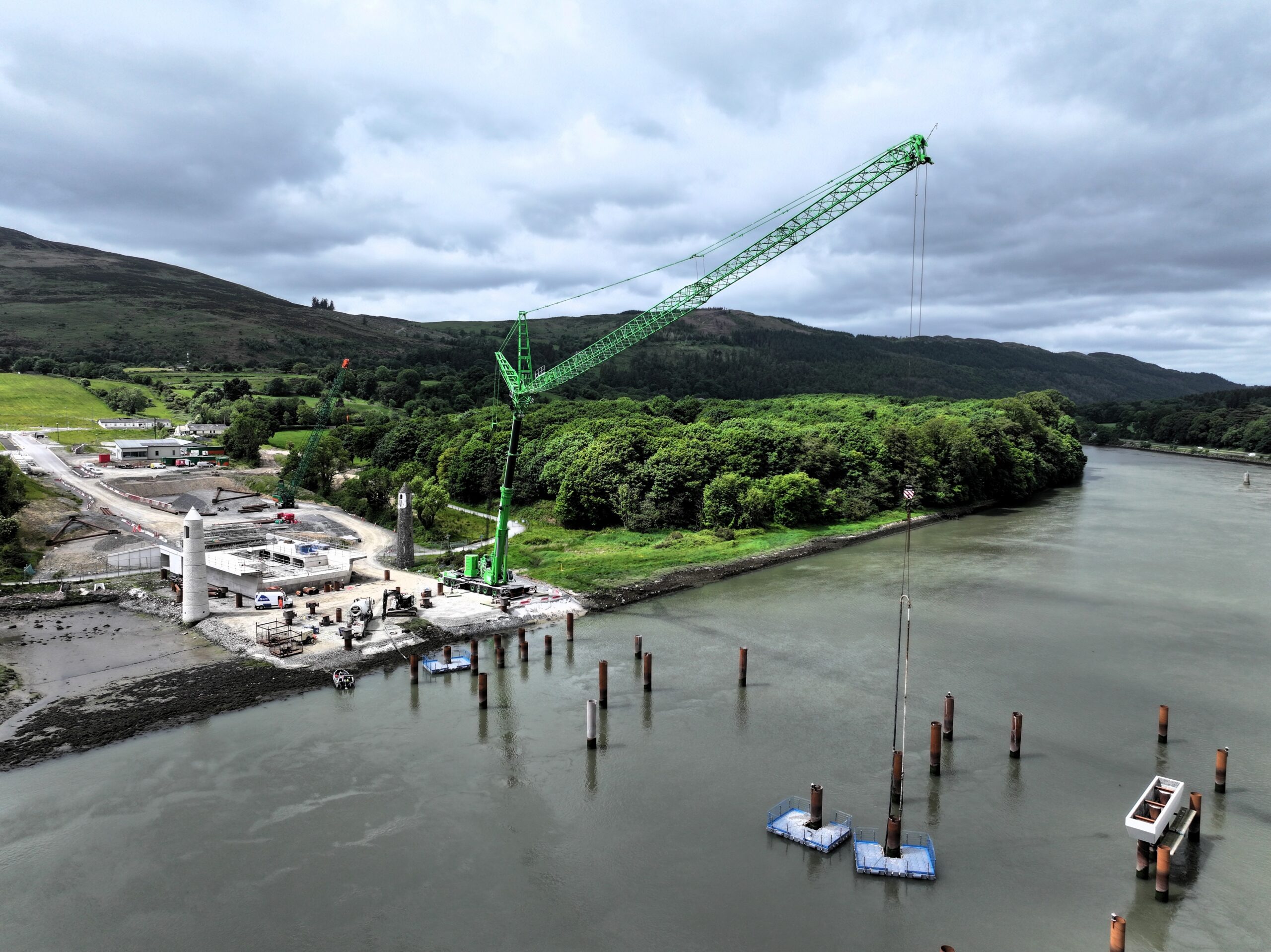
The steel for the fixed span of the Narrow Water Bridge has arrived at Warrenpoint Harbour. Louth County Council estimates construction will cost €128.54 million, with opening targeted for early 2028. The next job is getting the steel upriver and into position, on a crossing that has to work for boats as well as for people on the road.
The Narrow Water Bridge has reached Warrenpoint Harbour, but not yet in a form anyone could cross. Two steel deck sections and the pylon have arrived from Belgium. To get them to the construction site, crews have to move them upriver by barge, timing the operation around high tide and suitable weather. Then comes the job of putting them in position.
The crossing will link Cornamucklagh, near Omeath in County Louth, with Narrow Water, near Warrenpoint in County Down. It will carry road traffic, cyclists and people on foot, but it also has to leave a way through for boats. That’s why one section is designed to lift. It’s a detail that tells you what Louth County Council is building here: a new route across the water that has to work for people travelling along it, too.
From the harbour to the river
The first barge, the Caroline, left Belgium on 15 October with an 82-metre deck section and the 114-metre pylon on board. It travelled through Dutch canals and across the North Sea before reaching Carlingford Lough on 20 October and berthing at Warrenpoint Harbour. The council’s November report records the arrival of the other deck section on 31 October. By then, the three major steel components for this phase of the build had made the sea journey.
Getting them the last stretch upriver is a different job. The council’s 6 November report said crews were removing the fittings that held the components in place at sea and preparing temporary supports for the next move. On the southern embankment, a crane had been erected and had started installing beams for the temporary tracks. The tracks will let crews slide the steel into position once it has been transferred off the barges, rather than asking a single lift to do the whole job.
BAM, the main contractor, estimated that installing the fixed span and pylon would take eight to 12 weeks, depending on the weather and operating conditions. That estimate is for this phase of the work, not for getting the entire bridge ready for traffic. On the northern embankment, the council reported work continuing on the final wall pours for the opening span’s chamber and plant room. The steel arriving made the bridge easier to picture, but much of the work that will make it usable is on the banks or below deck level.
What the council expects construction to cost
Louth County Council’s 2027–2029 capital programme puts the estimated cost of the construction stage at €128.54 million. The Government announced a separate figure of €102 million plus VAT for the main construction contract, funded through the Shared Island Fund. One is the council’s estimate for the construction stage; the other is the price of the main contract before VAT. The documents do not give a like-for-like breakdown between those figures, so the difference cannot be read as a cost overrun.
The capital programme estimates that about €104.29 million will have been spent by the end of December 2026, with further expenditure expected in 2027, 2028 and 2029. That is a budget projection, not a statement of money already paid or a final bill. Louth County Council is delivering the project with the Department of Housing, Local Government and Heritage, with BAM carrying out the main works. For anyone tracking the scheme, the useful comparison as construction progresses will be between updated construction estimates and the same scope of work.
A road crossing that has to open for boats
The finished bridge is designed to span about 195 metres. Its shorter, northern span will include a moving section that lifts to allow marine traffic to pass. When the bridge is open to vessels, the project team says it will leave a clear channel 20 metres wide. The full opening cycle, from stopping road traffic to letting it move again, is expected to take around ten minutes in typical conditions, depending on how many vessels are passing.
The project also has to tell people when the road is about to close. The operating plan calls for signs to warn drivers and for signals and barriers to stop road users and people on foot during an opening. The roughly ten-minute estimate covers that whole sequence, not just the time it takes to lift the span. These arrangements bring the lifting mechanism, warning signs and traffic controls together, helping people approaching from either side understand when the crossing will reopen.
That moving section is being fabricated separately. The council expects it to be delivered to the site in October 2027, nearly a year after the fixed-span steel arrived at Warrenpoint. The published programme envisages the main construction works finishing in the final quarter of 2027, with testing and commissioning beginning around that point. The opening target is the first quarter of 2028, not a confirmed day for the first crossing.
There is a good reason to keep those milestones separate. A bridge deck can be in place long before traffic is allowed onto it. Here, the sequence includes fitting an opening span and getting a crossing that serves road and river traffic ready for use. Judging progress by whether the steel is in position will tell only part of the story.
What the crossing will change on both banks
The bridge will provide a direct link between the Cooley Peninsula and the Mourne side of the lough. For people on foot, the project team says the bridge path will meet the existing footpath on the A2 on the Warrenpoint side. On the Louth side, a ramp will connect the bridge access road with the Omeath–Newry Greenway. That connection is what makes the bridge useful for more than an end-to-end road journey: someone already walking or cycling along the shore will have a way onto the crossing.
The approaches matter just as much as the structure over the river. The project team’s published guidance describes a mix of footpaths, segregated cycle lanes and shared surfaces, rather than a single layout throughout. For a person arriving on foot from Warrenpoint or by bike from Omeath, the difference will be in how easy it is to pick up the next path.
For now, the works change one of those journeys in a different way. Louth County Council has closed the section of the Carlingford Lough Greenway between Lower Shore Road and Victoria Lock from 1 September 2026 to 28 February 2027 to allow construction to proceed. Walkers and cyclists are being diverted via the Fathom Line, Newry Road and Lower Shore Road. It’s a practical detail for anyone heading out along the lough before the bridge opens.
The Government is also backing work to find out what a better-connected lough might offer visitors beyond the bridge itself. In June, the Government announced support for a feasibility assessment and economic appraisal of a proposed Loop of the Lough, building on early work commissioned by Louth County Council. The idea is to link attractions on both shores, but it is still a concept, not an approved route or another opening to put in the diary. The bridge is the part already being built; the wider visitor offer will depend on what can be made to work around it.
The Bottom Line
Louth County Council can point to something tangible at Narrow Water: the steel for the fixed span and its pylon has arrived, and preparations to move it into place are under way. The council’s €128.54 million construction estimate puts a scale on the work, while the first quarter of 2028 remains the target for opening. Between now and then, the milestones that matter are getting the fixed span into place, fitting and testing the moving section, and making sure the paths and roads connect on both banks. The result will be a crossing designed to connect communities while keeping the river open to those travelling along it.