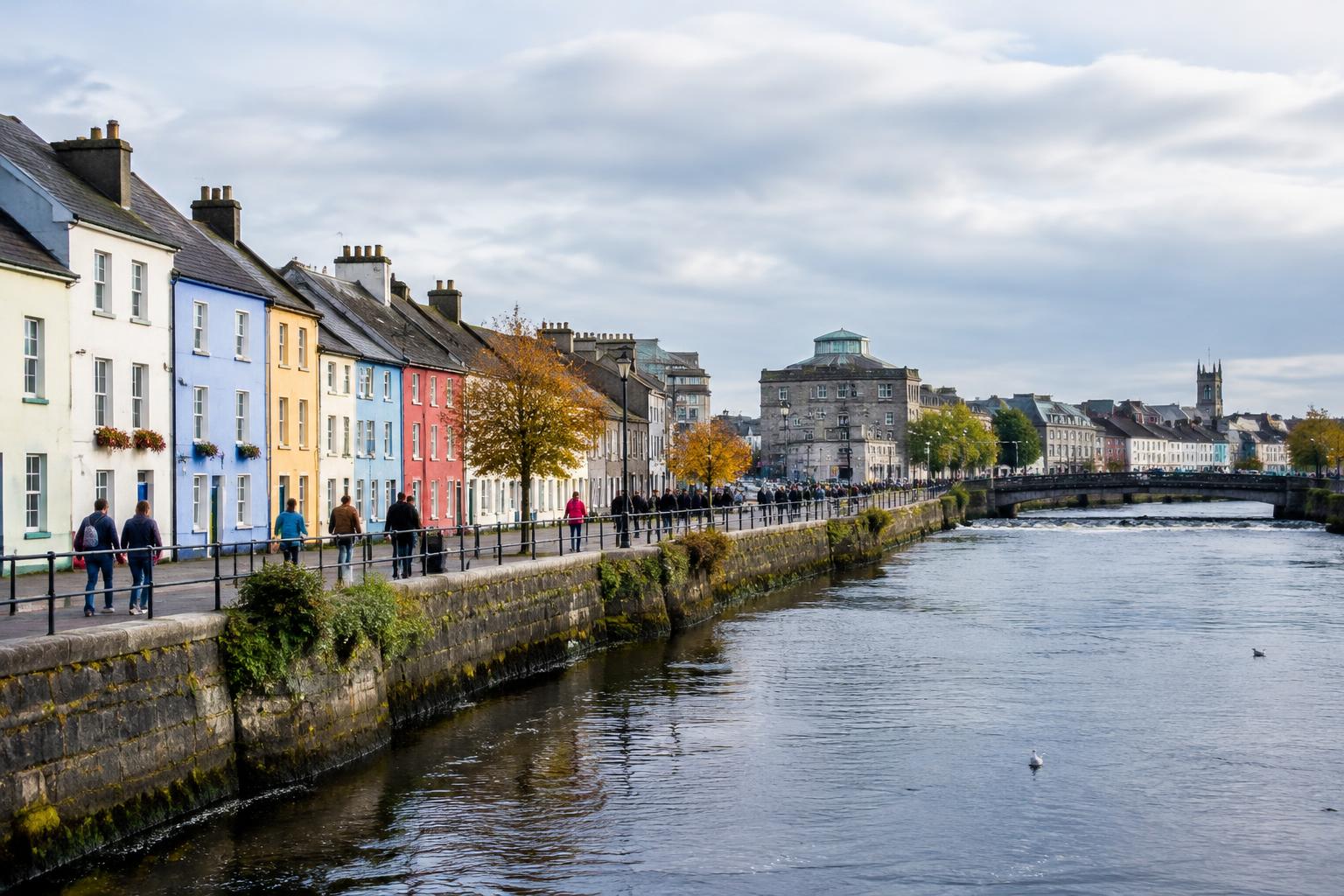
Galway City Council has asked Government to look again at how local authorities are funded, arguing that a city carrying the weight of a regional capital is working from the thinnest financial base in the country. The figures back up the council's case — and with reform already under discussion nationally, now looks like the right moment to act on it.
A City Asking a Fair Question
On 8 October 2026, Galway City Council called on Government to re-examine the funding model used to support local authorities, with a specific focus on reducing gaps in service delivery and public infrastructure across the Galway Metropolitan Area. The call came ahead of a council meeting the following week, and it was framed not as a complaint but as a request for a fairer, more sustainable basis for funding essential local services and capital projects — fitting for a city that is the largest urban centre in the Northern and Western region.
Mayor Cllr Helen Ogbu put the comparison plainly: "Galway City is operating on a financial platform behind every local authority in the country, including rural counties of Longford, Roscommon and Leitrim." She added that the council is "asking national Government to recognise Galway City's contribution to the region, and the country, and to provide a fairer, more sustainable funding basis for essential local services and capital projects."
Chief Executive Leonard Cleary made a similar point from the delivery side of the desk. "Galway City is a key growth centre, supporting national and regional development policy," he said, "however, simplistic weightings in the national funding models do not reflect this, resulting in a significant under weighting relative to other neighbouring local authorities, including Clare and Limerick." He confirmed the council will keep raising the issue with Government, calling an equitable model "essential for both service delivery, capital investment and for the Council's ability to co-finance development required to deliver obligations set out at national level."
This is a city that is growing and delivering. The Annual Service Delivery Plan 2026 outlines €161,201,146 in investment across services, amenities and capital projects, and the council is progressing 12 Priority Projects submitted to the national Programme for Government, alongside plans for 2,500 new homes on the Murrough lands. The ask for a better-calibrated funding model sits alongside, not instead of, that record of delivery.
How the Current Funding Model Works
Local authority spending splits broadly into two strands. Capital projects — astro pitches, cycle routes, community buildings — are mainly supported by national funding, topped up locally through development levies, borrowing and property or land sales. Then there are services: local authorities deliver over 1,000 of them, from street cleaning, recycling centres and severe weather response to libraries, abandoned vehicle removal, homeless supports, business grants, environmental monitoring and burial grounds. The full list is published at services.localgov.ie.
These services are funded through a mix of charges, state funding, commercial rates and the Local Government Fund (LGF). The LGF itself draws on three sources — Local Property Tax, motor tax and Exchequer payments. Crucially, motor tax and Exchequer payments do not apply to Galway City Council, which means LPT is effectively the council's primary route into the Fund.
How much of that LPT a council keeps, and how much is redistributed elsewhere through equalisation, depends on a baseline calculated using five weightings: population at 10 per cent, area at 35 per cent, deprivation at 20 per cent, locally raised income at 27.5 per cent and national policy priorities at 7.5 per cent. For a compact, high-density city like Galway, a formula weighted so heavily towards land area is a natural place to look for improvement.
Government has already shown the model can move. A Dáil parliamentary answer from 1 October 2026 confirms that, following a 2023 review, baselines for every local authority were adjusted across those same five criteria, with every council receiving a minimum increase of €1.5 million. Building on further increases in 2024, baselines nationally rose by a further €42 million — proof that recalibration is a live, workable process rather than a theoretical one.
Why Galway City's Numbers Stand Out
Galway City's population is 84,000, but that figure understates who actually relies on its services day to day. More than 30,000 students study in the city, and it welcomes over 2.4 million visitors a year. All of them use the roads, the parks, the libraries and the public realm, yet the city's compact geographic footprint does nothing to capture the traffic volumes and demand that come with being the region's hub for employment, education, healthcare, retail and tourism.
The LPT figures illustrate the gap clearly. Galway City will generate €10,339,596 in LPT locally in 2026, but its baseline for the year was set at €5,099,723 — the lowest of all 31 local authorities. The council retains €8,304,998 of what it raises, meaning roughly 20 per cent of the LPT paid by Galway City residents is redistributed to fund services in other local authorities.
The knock-on effect shows up in the city's own cultural and recreational offer. Facilities such as the Town Hall Theatre, Leisureland, community centres and sports pitches are heavily subsidised by locally raised income precisely because the baseline funding available to the city doesn't stretch to cover them. Parks, playgrounds, transport and arts and culture programmes all sit downstream of the same funding question.
What the council is asking for is specific and reasonable: a baseline that reflects not just resident population but student numbers and the daily inflows of people coming into the city for work, education, healthcare, retail, tourism and public services. That would bring the formula closer to the reality of how a regional capital actually functions.
A Moment of Opportunity: Reform Already Under Way
Galway City's case lands at a useful moment. Budget 2027, delivered on 6 October 2026, gave the Department of Housing, Local Government and Heritage a record allocation of €11.92 billion, with €755 million flowing through the Local Government Fund. On top of that, Government confirmed a new annual envelope allowing local authorities with the means to spend or borrow an additional €200 million a year on capital projects — a sign that financial flexibility for councils is already firmly on the national agenda.
That flexibility sits alongside a wider reform process. The Local Democracy Taskforce published its Final Report in March 2026, built around four themes: Structures, Funding, Functions and Governance. Galway City Council welcomed the implementation of that report on 30 July 2026, including its commitment to expanding local discretion — a natural vehicle for exactly the kind of baseline recalibration the council is now seeking.
The council's own delivery record makes the opportunity cost of an outdated model clear. With €161.2 million already going into services, amenities and capital projects in 2026, and 12 Priority Projects advancing under the national Programme for Government, Galway City is demonstrating what it can do within a model it says underweights it. A fairer baseline wouldn't create new ambition — it would let existing ambition go further, faster.
The 2023 baseline review and the follow-up €42 million increase show Government is willing to revisit these weightings when the evidence supports it. Galway City's figures — the lowest baseline of all 31 local authorities, set against a growing, high-footfall regional capital — are exactly the kind of evidence that process exists to respond to.
The Bottom Line
Galway City Council isn't arguing against the funding model in principle — it's arguing that the weightings inside it haven't caught up with what the city has become. A regional capital serving 84,000 residents, more than 30,000 students and 2.4 million annual visitors needs a baseline that reflects that reality, not one built mainly around land area.
The good news is that the tools to fix this already exist. The 2023 review, the subsequent baseline increases, the Local Democracy Taskforce's funding theme and Budget 2027's new capital flexibility all point to a system that is actively being recalibrated, not one standing still. Galway City's request fits squarely within that momentum rather than against it.
With the council's own Chief Executive committed to continuing the conversation with national Government, and a Mayor making the comparison to rural counties plainly and publicly, this looks less like a grievance and more like a well-timed contribution to a reform process already under way. Other growth centres watching how LPT baselines are calculated may well be taking notes.
Galway City has made its case with its own numbers, not assumptions: a baseline that is the lowest of all 31 local authorities, a fifth of locally raised LPT going elsewhere, and a service and capital delivery record that keeps pace regardless. That combination is precisely what a funding model review should be designed to catch — and precisely why Galway City's call deserves a serious hearing.