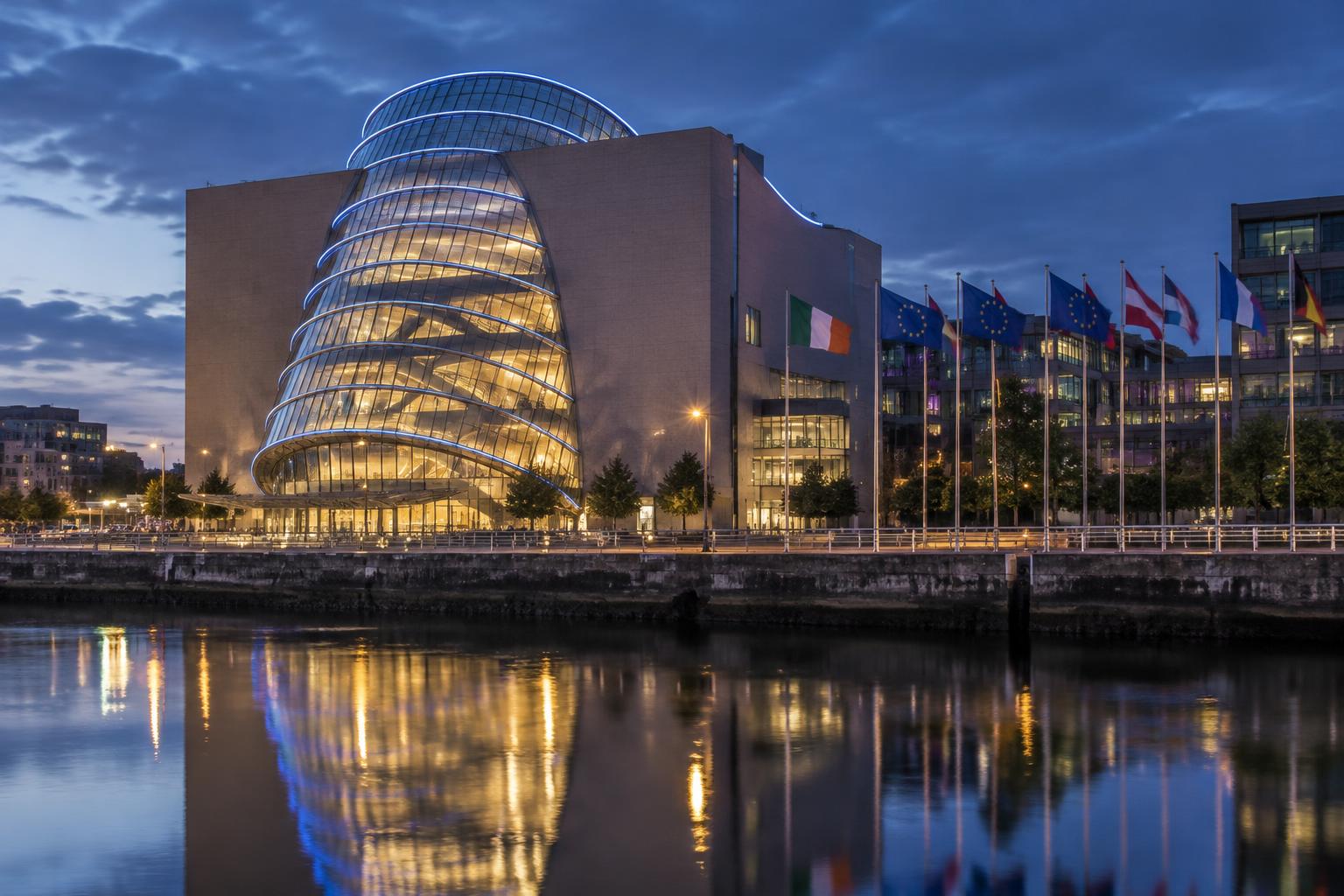
Next Thursday and Friday, around 50 European leaders will meet at the Convention Centre Dublin for the ninth European Political Community summit and an informal meeting of EU heads of state or government. It is the largest gathering of its kind Ireland has ever hosted — and a showcase for how every level of Irish government works together.
What Is Happening, and When
On Thursday 12 November 2026, Taoiseach Micheál Martin will chair the ninth meeting of the European Political Community (EPC) at the Convention Centre Dublin on North Wall Quay. Around 50 European heads of state and government, together with the leaders of key European and international institutions, are expected to attend. The Department of the Taoiseach is organising the meeting as part of Ireland's Presidency of the Council of the European Union, which runs from 1 July to 31 December 2026.
The following day, Friday 13 November, the same venue will host an informal meeting of EU Heads of State or Government. That meeting brings together the leaders of all 27 EU member states, joined by European Council President António Costa, who will chair it, and European Commission President Ursula von der Leyen.
On the Thursday evening, the Taoiseach will host a dinner for visiting leaders at the National Gallery of Ireland. Taken together, the two days amount to the largest gathering of heads of state and government that Ireland has ever welcomed. For a country of just over five million people, that is a remarkable vote of confidence in Ireland's place at the centre of European conversation.
What the European Political Community Is
The European Political Community is a forum that reaches well beyond the EU. It brings EU member states together with countries such as Norway, Iceland, Switzerland, the United Kingdom, Ukraine, Moldova, Georgia, Armenia and the nations of the Western Balkans. Its purpose is informal political and strategic dialogue — leaders sitting around the same table to talk openly about security, stability and prosperity across the whole continent.
Unlike a formal European Council, the EPC does not adopt legislation or binding conclusions. Its value lies in the relationships it builds and the space it creates for frank, direct conversation. Previous meetings have been held in Prague, Moldova, Spain, the United Kingdom, Hungary, Albania, Denmark and, most recently, Yerevan in Armenia in May 2026. Dublin now joins that list as the ninth host city.
Friday's informal EU leaders' meeting has a sharper focus. In his invitation letter of 3 November, President Costa confirmed that discussions will centre on artificial intelligence — the first dedicated discussion of AI at leaders' level. Leaders will hear from Arthur Mensch, chief executive of Mistral AI, on Europe's position in the global AI landscape, and from Nobel laureate Professor Geoffrey Hinton. The discussion builds on the leaders' agreement earlier this year that 2026 should be the 'Year of Competitiveness'. Hosting that conversation in Dublin, home to so much of Europe's technology sector, is a natural fit.
What It Means for National Government
For the Government, these two days are the high point of a Presidency that is already delivering. On 3 November, Minister for Foreign Affairs and Trade Helen McEntee briefed Cabinet on progress made in October. The Presidency presented its compromise proposal for the EU's next long-term budget, the Multiannual Financial Framework, and secured the Council's position on major files including the Market Integration and Supervision Package, the 'EU Inc.' corporate legal framework and initiatives to simplify EU regulation. Significant measures in support of Ukraine were agreed, and further progress was made on EU enlargement.
The scale of the work behind the scenes is considerable. By early November, Ireland had hosted 19 informal ministerial meetings and 176 other Presidency meetings and events in locations across the country. Irish ministers had chaired 13 formal Council meetings in Brussels and Luxembourg, and Irish officials had led more than 1,000 meetings of member state representatives. The Dublin summits bring that effort into one public moment.
There is also a clear diplomatic dividend. Chairing the EPC gives the Taoiseach a platform to set the tone of the conversation, to welcome leaders personally and to strengthen relationships that matter to Ireland long after December. For a small, open economy that depends on trade, investment and a stable neighbourhood, having Europe's leaders in the room in Dublin is an opportunity that rarely comes around.
Tánaiste Simon Harris has been clear that the Government is taking the security of the events "extraordinarily seriously", and he has thanked the men and women of An Garda Síochána and the Defence Forces for what he described as the "tireless work" they have done throughout the Presidency.
What It Means for Local Government
Summits of this size are not delivered by central government alone. Teams from the Department of the Taoiseach, the Department of Foreign Affairs and Trade, the Office of Public Works, An Garda Síochána, Dublin City Council and transport operators have been planning together intensively for months. For local government, that is a powerful example of the practical, behind-the-scenes role councils play when the country steps onto the world stage.
Dublin City Council's contribution covers the everyday work that keeps a city running under exceptional circumstances: traffic management and road closures in partnership with gardaí, street cleaning and public realm presentation along the quays, coordination with businesses and residents, and making sure essential local services continue. The north Docklands — itself the product of decades of council-led regeneration — becomes, for two days, the face of Ireland to Europe.
The Presidency has also reached well beyond the capital. Its informal ministerial meetings and events have been held in venues around the country, bringing European delegations to towns and cities whose councils, tourism teams and local businesses have helped host them. That spread means the benefit of the Presidency is felt nationally, not only in Dublin.
For councils, there is a policy dimension too. Many of the issues on Europe's agenda — housing, the energy transition, competitiveness, migration and the digital economy — are delivered on the ground by local authorities. Leaders' discussions on AI and competitiveness will shape EU funding and regulation that councils use every day, from digital public services to regional enterprise supports.
What Residents and Businesses Should Know
An Garda Síochána has described the policing and security operation as the largest in the history of the State. It will begin on Tuesday 10 November and build gradually through Wednesday 11 November, ahead of the summits on Thursday and Friday. Garda units involved include front-line policing, public order, the Special Detective Unit, the Emergency Response Unit, Air Support and the National Drone Unit, with the overarching aim of keeping everyone who lives, works and studies near the venues safe.
Gardaí have said they are working to keep the operation proportionate and to minimise restrictions. People travelling in Dublin city between Tuesday and Friday are being asked to plan ahead and allow extra time. The National Transport Authority has advised that bus routes across the city may be affected by diversions, and that while real-time information will not appear on stop display boards, it will remain available through transport apps. Up-to-date route information is being published on the NTA website.
For businesses near the Convention Centre and the city centre, the advice is simple: check the official updates, talk to staff about travel plans, and treat the week as a chance to welcome the international attention that comes with it. Thousands of delegates, officials and journalists will be in the city, and many will carry their impressions of Dublin home with them.
The Bottom Line
Next week, Europe's leaders gather in Dublin for the largest summit Ireland has ever hosted — an EPC meeting on Thursday and an informal EU leaders' meeting on artificial intelligence on Friday. For the Government, it is the high point of a productive Presidency and a rare chance to shape Europe's conversation from home. For local government, it shows the quiet, essential work councils do alongside national agencies when the country is on show. Plan your journeys, follow the official updates, and take pride in a moment that puts Ireland, and its public servants at every level, at the heart of Europe.