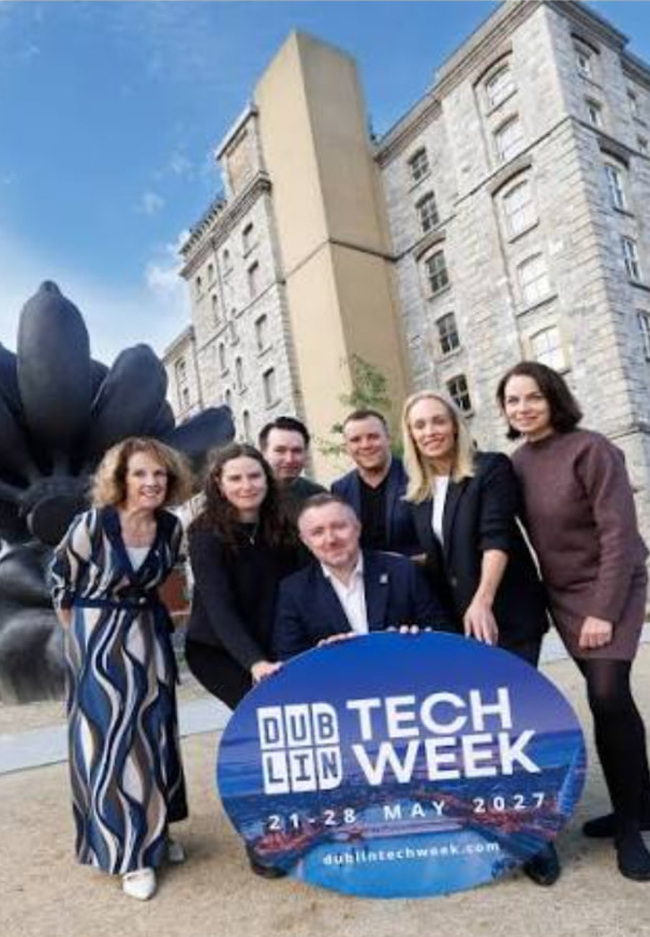
Dublin Tech Week returns from 21 to 28 May 2027, and organisers want companies, communities, educators and creatives across the city to help build its programme.
Dublin Tech Week is coming back. The city-wide programme will return for a third year from 21 to 28 May 2027, and the call has already gone out for people to help fill it. Companies, communities, educators and creatives across Dublin are being invited to organise an event or activity as part of the week. The invitation is deliberately broad, because the whole idea rests on the city supplying its own content.
That open-door approach is what sets the week apart. It is not a single conference in a single venue. It is a programme that stretches across the city and takes in flagship conferences, company open houses, children's coding workshops and much more besides. Some events are ticketed, many are free, and all of them are listed in one place. The aim is simple: whether you live in Dublin or are visiting, you should be able to find your way to the events that interest you.
With two editions now complete, anyone weighing up whether to get involved has a practical question to ask. How is it actually going? The numbers so far show steady progress in the right direction.
From 45 Events to a City-Wide Programme
The first Dublin Tech Week took place in 2025 and brought together 45 events and more than 12,000 participants. For a new initiative that relied on organisations to put forward their own events, that was a solid foundation. It showed there was an appetite among the people putting events on and among the people turning up to them. It also gave everyone involved something to build on for year two.
In 2026 the programme expanded to over 70 events, with participation in excess of 18,000. The second edition ran from 22 to 29 May 2026 and took in flagship conferences, company open houses, coding workshops for children, hackathons, cybersecurity sessions and exhibitions. That spread matters as much as the headline totals. A week that can hold a hackathon and a children's library workshop in the same programme is reaching very different audiences at once.
The growth has not come from a top-down plan to fill a calendar. It has come from more organisations deciding the week is worth their time and putting their own events forward. That is a healthy sign for any community-led project, because it means the people closest to the sector see value in being part of it. Each new organiser also brings their own network, which helps the week reach a little further every year.
A Week Built by the People Who Take Part
Dublin Tech Week is a community-led initiative, and the description fits. The programme is built by the people who choose to take part. That includes startups, corporates, universities, libraries, meetup groups and civic organisations. Nobody is simply handed a slot. They create one and bring their own audience with them.
Ross Curley, Chair of Dublin Tech Week and Head of Economic Development at Dublin City Council, sees that openness as central to what the week is for. "Dublin Tech Week reflects the energy, innovation and diversity that define Dublin and its wider region," he said. "As a community-led initiative, it creates opportunities for people of all backgrounds to engage with technology, share ideas and build new connections."
He continued: "By opening the sector to a wider audience, the week helps foster a more inclusive innovation ecosystem while showcasing the talent and creativity that make Dublin a leading European tech hub."
Coming from the council's head of economic development, that is a revealing emphasis. It frames technology as something residents, families and newcomers can walk into and explore, rather than a closed industry for specialists. The week gives that idea a practical shape, with free events sitting alongside ticketed ones.
There is a clear economic backdrop too. ICT accounted for 10.8% of employment in Dublin at the end of 2025, making technology a significant part of the city's economy. Dublin Tech Week offers a chance to show what that looks like at street level. It welcomes anyone who is curious, whether they already work in the sector, are wondering where it might take them, or simply want to see what goes on behind the office doors.
What the 2026 Programme Looked Like on the Ground
The clearest way to understand the week is to look at what actually happened in 2026. At one end of the scale sat Dublin Tech Summit 2026, a flagship event that anchored the programme. Alongside it ran an SME Breakfast Meeting, giving smaller businesses their own space within the week. Machine learning enthusiasts gathered at an ML Dublin meetup with Bank of Ireland, adding a deeper technical strand.
The week also reached well beyond the city centre. In Fingal, a tech day at the Riot Games Remote Broadcast Centre was hosted with Fingal County Council. In South Dublin, libraries in Clondalkin, Tallaght and Palmerstown ran coding and pixel workshops for children. For families in those areas, the week arrived on their doorstep. Those library sessions are a good example of the week doing exactly what it sets out to do.
A child learning to code at their local library and a founder networking over breakfast are part of the same story. Dublin Tech Week treats them as equally important, and the programme reflects that. It also shows what is possible when councils across the Dublin region work with partners on the ground. Libraries are trusted, accessible public spaces, and using them brings technology into neighbourhoods rather than asking people to travel to it.
The Partners Behind the Platform
Behind the programme is a broad coalition of partners drawn from across the city's tech ecosystem. Dublin City Council and Smart Dublin are joined by Dublin Chamber, DCU, Dogpatch Labs, Fáilte Ireland's Dublin Convention Bureau and Dublin Tech Summit. The list continues with the Guinness Enterprise Centre, the Local Enterprise Office, the LGMA and the Dublin Regional Skills Forum. Rinn AI, TU Dublin, Trinity College Dublin and Tech Ireland are also among the supporters.
That mix is worth pausing on. It brings local government, enterprise support, universities, tourism, skills and the startup community together in a single effort. Each partner reaches a different group of people, which is exactly what a community-led week needs. Together they are helping to build a platform for discovery, talent and investment that continues well beyond the week itself.
Seen through that lens, each partner adds something distinct. Fáilte Ireland's Dublin Convention Bureau links the week to people visiting the city. The Dublin Regional Skills Forum and the universities link it to talent, while the Local Enterprise Office links it to small businesses. Dogpatch Labs, the Guinness Enterprise Centre and Tech Ireland bring the startup community firmly into the frame.
With the 2027 dates now confirmed, the invitation to organisers is open. Anyone interested in running an event or activity between 21 and 28 May 2027 is encouraged to visit dublintechweek.com for information on how to list it. It could be an open house, a workshop, a meetup or an exhibition, ticketed or free. The conversation is already under way at #DublinTechWeek.
The Bottom Line
Dublin Tech Week is heading into its third year with real momentum behind it. It grew from 45 events and more than 12,000 participants in 2025 to over 70 events and more than 18,000 participants in 2026. That growth was driven by the organisations that chose to take part, from major companies to local libraries. It is a model that relies on the city showing up for itself, and so far the city has done exactly that.
For Dublin City Council and its partners, the week is a chance to show residents and visitors what a sector accounting for 10.8% of employment in Dublin looks like up close. For anyone with something to share, from a children's coding class to a company open house, the 2027 programme is open for entries. The more people who put something on, the more the week has to offer. That is the simple idea at its heart, and two editions in, it is working.