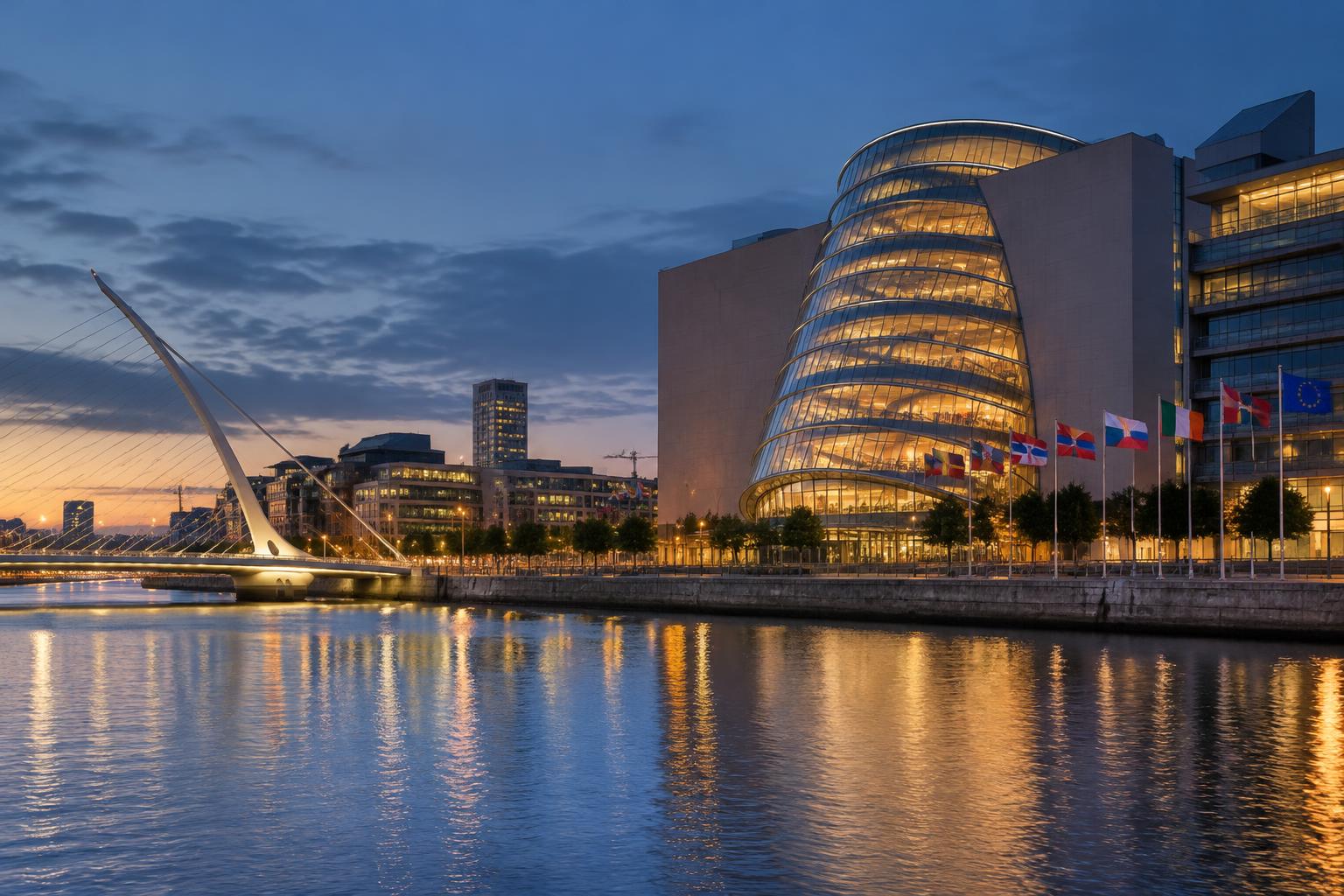
Dublin’s European gatherings have concluded. The European Political Community summit on 12 November and the informal EU leaders’ meeting on 13 November put Ireland at the centre of a major diplomatic week. Looking back, their significance reaches from national relationships to the local planning, transport coordination and public services that supported the capital’s role as host.
A Week Unlike Any Other in the Capital
On Thursday 12 November, Taoiseach Micheál Martin welcomed around 50 leaders to the Convention Centre Dublin for the ninth meeting of the European Political Community (EPC). The guest list stretched from Iceland to Armenia. It included Ukrainian President Volodymyr Zelenskyy, European Commission President Ursula von der Leyen, European Council President António Costa, NATO Secretary General Mark Rutte and, as a special guest, Canadian Prime Minister Mark Carney.
The Department of the Taoiseach described it plainly in its own announcement on the day: ‘This is the biggest gathering of international leaders that Ireland has ever hosted.’ RTÉ’s Europe Editor Tony Connelly called it the largest diplomatic undertaking in Irish history and the logistical high point of Ireland’s EU Presidency, which runs until 31 December.
On Friday 13 November, the focus moved to a second meeting at the same venue. The informal meeting of EU Heads of State or Government, chaired by President Costa, brought EU leaders together outside the usual Brussels setting. According to the Presidency’s briefing material, its programme included a strategic discussion dedicated to artificial intelligence, covering both its opportunities for competitiveness and its safety and societal impacts. That published agenda explains the meeting’s intended focus; it should not be confused with a confirmed agreement or a new programme of spending.
Between the two meetings, the Taoiseach hosted leaders at a dinner in the National Gallery of Ireland on Merrion Square. In the space of a week, two of the capital’s best-known public buildings carried Europe’s agenda, and they did so in full view of the world’s media.
What Was on the Table: Security, Economy and Connection
The EPC met under the theme ‘Europe – strong, secure and connected’. The Government set out four areas for discussion: strengthening Europe’s economy in the face of geopolitical challenges, promoting innovation and connectivity across the continent, supporting Ukraine, and addressing hybrid threats and efforts to undermine democracy.
Opening the summit, the Taoiseach told leaders that ‘our European security environment has been fundamentally reshaped by Russia’s brutal war’, as reported by BBC News. That set the tone for a day in which Ukraine’s future was the central subject. President Zelenskyy was one of only three leaders invited to address the opening plenary directly, alongside the Taoiseach and President Costa.
NATO’s own account of the day records that Secretary General Rutte used his visit to stress continued support for Ukraine and a whole-of-society approach to resilience. He also held bilateral meetings in Dublin with Danish Prime Minister Mette Frederiksen, Polish Prime Minister Donald Tusk and President Zelenskyy.
The EPC does not issue binding communiqués. Its value lies in conversation, and in giving EU and non-EU leaders one room in which to talk. That is why the setting mattered. Dublin provided a shared meeting place on the north quays of the Liffey, with Ireland hosting the EPC and President Costa chairing the separate EU leaders’ meeting. The two formats served different purposes, but together created an important opportunity for diplomatic engagement.
A Diplomatic Moment With Ireland at the Centre
The week’s importance lay partly in the breadth of contact that a gathering of this kind makes possible. Alongside formal sessions, leaders had opportunities for bilateral conversations and exchanges with the EU institutions and international partners. For Ireland, hosting brought those relationships into one place. The lasting significance is not that every conversation produced an immediate announcement, but that direct engagement can support the patient work of diplomacy long after visiting delegations have returned home.
For the Government, the significance was practical as well as symbolic. Face-to-face contact with leaders and international partners provided opportunities to reinforce Irish priorities on competitiveness, energy cooperation and digital innovation. Those relationships remain relevant as the Presidency continues towards its conclusion at the end of December.
The week also demonstrated State capacity at scale. Gardaí led what they describe as the largest policing and security operation in the history of the State, supported by the PSNI and police colleagues from Latvia and Portugal, according to the BBC. Planning of that scale, delivered calmly, is the kind of reputation that brings future international conferences, investment visits and major events to Ireland.
Where Local Government Fits In
Summits are hosted by the State, but they happen in a city. The streets, bridges, traffic signals, public realm and local information channels that supported the gatherings belong largely to local government, and Dublin City Council was a central partner in the preparations. Looking back at the week means recognising that contribution alongside the leaders’ meetings themselves.
As early as 4 November, the Council published clear public advice on what to expect. It flagged ‘major and prolonged traffic disruption’ around the Docklands and approach roads from 10 to 13 November, explained the closures around the Convention Centre and Samuel Beckett Bridge, and set out the additional closures around Merrion Square and Pearse Street for the National Gallery dinner. It encouraged commuters to plan ahead and to use public transport, walk or cycle where possible.
Behind the scenes, the Council’s Transportation and Public Realm Department managed the roadworks calendar around the Presidency. Its weekly traffic bulletin confirmed that during the week beginning 9 November there would be no works permitted in the city centre, and that some road permits could be withdrawn on the direction of a Council official or An Garda Síochána. Clearing the city of roadworks for a full week is a quiet but significant piece of coordination.
The cooperation extended across agencies. Transport for Ireland published detailed travel guidance for bus and Luas Red Line passengers. Garda updates confirmed that access for residents and businesses inside the Docklands cordon remained open, with security checks, and that engagement had taken place directly with those most affected. The IFSC kept its business community informed of the timings day by day. Together, those bodies showed what joined-up public service looks like under pressure.
For residents and traders in the north and south Docklands, the week required adjustments to normal journeys and routines. The early communication from the Council and its partners gave people information with which to plan. Now that the gatherings have ended, that preparation offers a useful reference for other local authorities hosting major events: explain the arrangements early, make practical advice accessible, and coordinate public information across the organisations involved.
What It Means for Councils Across the Country
The lessons from Dublin reach beyond the capital. Ireland’s EU Presidency has brought ministerial meetings and events to venues around the country, and councils in every region are part of how Ireland presents itself to visiting delegations. Well-maintained streets, welcoming town centres and confident local services are part of the national story Ireland tells.
The subjects on the summit table also land directly on council desks. Energy cooperation shapes local climate action plans and retrofit programmes. Connectivity and innovation link to broadband, active travel and smart-city projects that local authorities are already delivering. Resilience against hybrid threats and disinformation connects to council emergency planning and to the trusted public information local government provides every day.
Artificial intelligence remains particularly relevant. Councils are exploring how digital tools can improve planning, customer service and the management of public assets. The place of AI on Friday’s published agenda highlights its importance to European policy. For local authorities, the practical task remains to assess useful applications carefully, protect people’s information and follow the applicable rules. A leaders’ discussion does not itself authorise a council system or create a new funding allocation; local decisions still require their own proper process.
There is also a valuable body of experience to carry forward. Preparing for a diplomatic gathering of this scale brought national and local public administration together around a shared programme. The arrangements for streets, transport advice and public communication provide practical material for future event planning. Councils can draw on that experience when preparing for international sporting fixtures, large cultural festivals and other occasions that bring visitors into their communities, adapting the lessons to local needs and circumstances.
The Bottom Line
With the gatherings concluded, Dublin’s European week was an important moment in Ireland’s Presidency. Around 50 leaders came for the EPC, followed by the separate EU leaders’ meeting. For the Government, the enduring value lies in diplomatic access, continued engagement and experience of hosting a major international programme.
For local government, the look back brings a clear contribution into view. Dublin City Council’s early planning, public advice and coordination of the city’s streets supported a national diplomatic occasion. The meetings have ended, but the practical lessons remain: national events depend on local knowledge, accessible information and cooperation between public bodies. Councils across Ireland can take encouragement from that shared work as they prepare their own major events and continue delivering the everyday services on which welcoming places are built.